
Social Medicine for Sara
October 1, 2025
By Fei Tang, Senior Manager, Strategic Initiatives, Access Alliance & Marco Campana, Knowledge Mobilization and Social Action Coordinator, Access Alliance
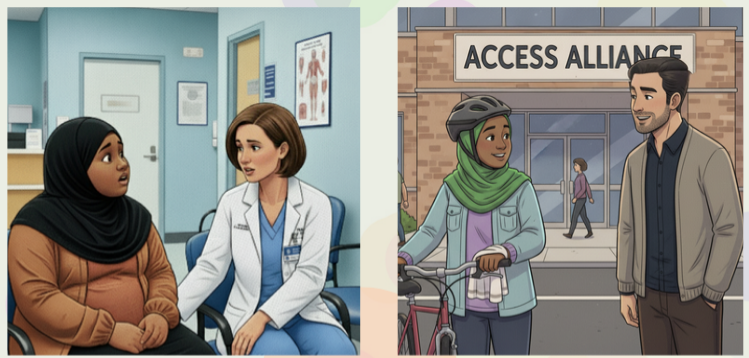
Our Social Medicine for Sara comic book tells the story of how a newcomer youth benefits from social prescribing. Her story is based on the stories of real clients of our Youth Wellness Hub.
Fifteen-year-old Sara, a Black Muslim girl, has just arrived in Canada to join her mother, a personal support worker who works demanding night shifts. With no friends and a language barrier, Sara feels isolated. Struggling with her weight, she believes that losing a few pounds will solve all her problems.
Following internet “advice”, she takes some herbal medicine from back home, which leaves her with a persistent stomachache. Her journey for a cure leads her to the doors of Access Alliance, a community health centre, where she discovers that social medicine can sometimes be the best prescription for healing.
About Social Prescribing
Youth mental health is a “wicked” problem, one that cannot be resolved through a single, siloed approach, medical or non-medical. Social prescribing offers a systems-based solution by connecting critical factors essential for restoring mental well-being. Through the Youth Wellness Hub, a system navigator (case manager) uses social prescribing methodologies to address key social determinants of youth mental health.
Social prescribing involves a community. Collaborating with internal and external service providers, the system navigators or link workers support clients at risk of mental health deterioration, connecting them in their community with therapy, nutritious food, housing assistance, employment opportunities, and supportive networks with peers, mentors and service providers.
Access Alliance has been focused on social determinants of health since our inception in 1989. Although social medicine and social prescribing have long been tacitly implemented in our decades-long interdisciplinary and team-based practices, the intentional, structured, and impact-traceable social prescribing modality has been a recent innovation. We are transforming our entire team’s approach from “what’s the matter with you?” to “what matters to you?”, as Dr. Kate Mulligan aptly put it.
For more on why social prescribing with a health equity lens is essential to creating real system access, check out the recent keynote presentation by Natasha Beaudin at the HSDNI sustainability Collaborative Conference.