
Federal by-elections in Toronto – be an informed voter
March 16, 2026
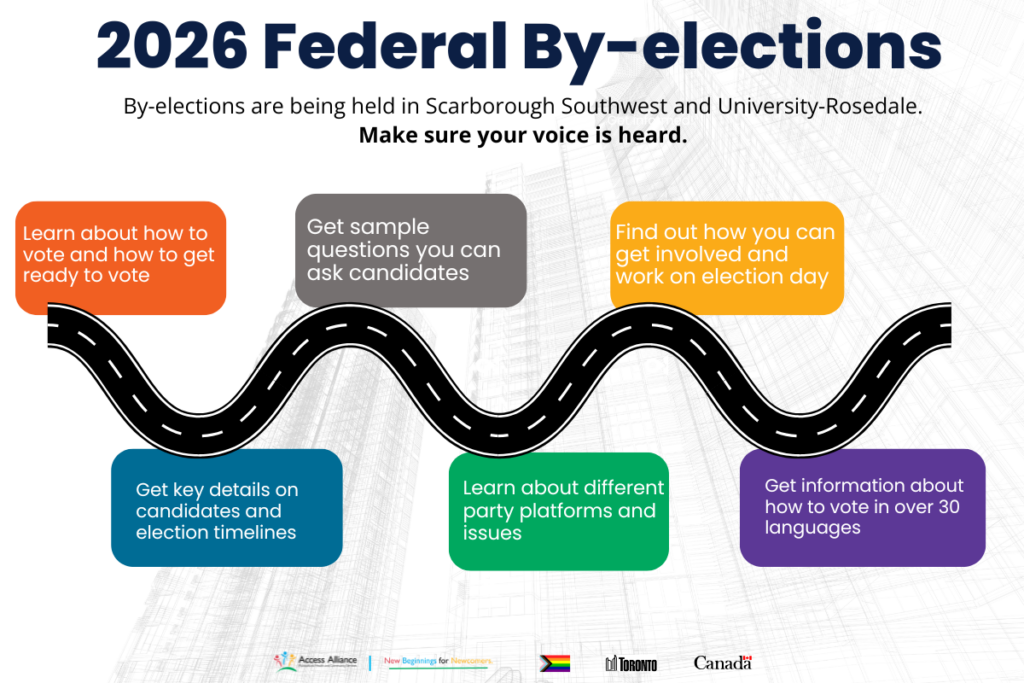
On April 13th, two federal by-elections are coming up in two Toronto communities:
The Canadian government touches many areas of our lives. This voter information toolkit will help you understand if you can vote, and why you should vote if you can. It also has details about election jobs, and where you can get more information.
To vote in the federal election, you must:
- Be a Canadian citizen
- Be at least 18 years old on election day
- Prove your identity and address, including that you have lived in the riding from March 8, 2026
You can vote even if:
- You are unhoused
- You’re a student away from home
- You do not have ID
If you can’t vote, there is still plenty you can do.
In this post:
- Learn about how to vote and how to get ready to vote
- Find out about election-related activities at our AccessPoint on Danforth location
- Learn key details about candidates and election timelines
- Get sample questions you can ask candidates
- Learn about different party platforms and issues
- Find out how you can get involved and work on election day
- Get information about how to vote in over 30 languages
We have created two voter information toolkits (one for each by-election) you can download and share. They have all the information that we’re sharing in this post.
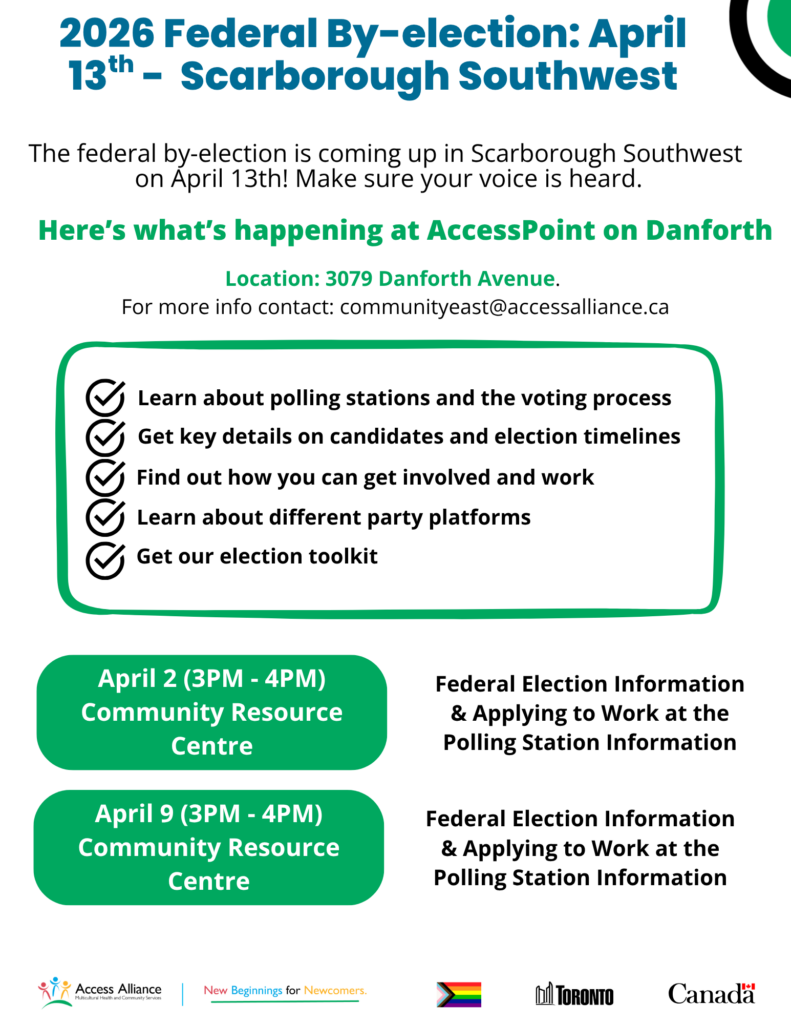
If you are looking for some in-person information and support, join us at AccessPoint on Danforth for on April 2nd and 9th for information sessions:
Get ready to vote!
The Elections Canada by-election pages have all the information you need on how to vote, including mail-in voting, how to get on the voter’s list, voting options, key dates, and more. They also have translated materials available in over 30 different languages!
Each page has a frequently asked question section with all the information you need to get ready to vote.
Candidates and election timelines
Find information about local candidates here (the list will be finalized by March 25th):
Some key dates:
Learn about your local candidates – on March 25th (Elections Canada will finalize the list with the confirmed candidates. You can find your electoral district here and see the list of candidates – after March 25th – as well as helpful answers to frequently asked questions like:
- Where do I vote?
- Am I registered to vote?
- What pieces of ID do I need to vote?
If you are registered you should receive your voter information card by April 11th. Not yet registered? Confirm, update or add your voter information to the Voter Register by April 7th.
Apply to vote by mail before April 7th.
Vote in advance between April 3rd and 6th.
What does your candidate stand for?
Here are some sample questions you can ask your candidate to find out where they stand on important issues that can affect you and your community:
Healthcare
- What steps would you take to help more people get healthcare while making sure doctors and nurses aren’t overworked?
- Many people can’t afford mental health help and must wait too long to get it. How would you make mental health care more accessible for everyone?
Decent work
- How would you protect all workers’ rights, no matter what kind of job they have or who they are?
- What will you do to improve the employment prospects, and equal pay for equal work, at all skill levels?
Food security
- How would you ensure that everyone can afford the basics?
- How would you expand and create new income supports for workers and people on fixed incomes? How would you ensure poverty-reducing policies are racially equitable, and reach the communities most at risk of food insecurity?
Environment and sustainability
- What will you do to support and expand public transportation?
- How will you work to advance environmental justice and protect the vulnerable communities currently bearing the brunt of climate change?
- How will you hold corporations that pollute our air and water accountable?
- How will you ensure all communities receive equitable access to clean air and water, as well as equitable response to climate disasters such as wildfires, storms and flooding?
Affordable Housing
- What would you do to help make housing cheaper and better in Toronto, and how would you protect renters?
Newcomers
- How will you support the immigrant and refugee serving-sector to deliver appropriate settlement services to immigrants and refugees, so they’re supported to reach their full social, political and economic potential?
- What does your party propose for improving protections and settlement services for 2SLGBTQI+ refugees?
These are just some topics to consider. If you are interested in learning more the organizations below have created useful topic and issue summaries, along with additional questions you can ask candidates. These websites were created for the 2025 federal election, but the information is still useful for this by-election:
Different party platforms and issues
Find information about the main four provincial parties and their platforms:
How you can get involved and work on election day
Find out how you can get involved and work on election day in Scarborough Southwest and in University-Rosdale.
Poll workers mainly work at polling places, where electors go to vote. Various positions are available, from the deputy returning officer, who handles the ballots, to the information officer, who directs electors to the appropriate table. To work as a poll worker, you must:
- Be a Canadian citizen;
- Be at least 16 years old on election day;
- Be non-partisan and not participate in any partisan political activity while you work for Elections Canada.
Get information about how to vote in over 30 languages
Elections Canada has translated materials in over 30 different languages, including:
- A guide to the federal election – general information about how to vote
- A voter Identification information sheet – how to prove your identity and address