
Scaling equity-based attachment means being ready for more than just matching

Overview
As we move towards Ontario’s 2029 primary care attachment goal, we face a choice. We can build an attachment system based strictly on administrative matching by counting numbers. Or we can build a system that invests and values engagement, access, and equity equally, to create true attachment based on readiness, relationships, and structural supports.
We recently conducted a study that advocates for a policy shift toward standardized onboarding and navigation infrastructure to ensure equitable, sustainable, and longitudinal care.
Why it matters
Successful primary care attachment is not a singular administrative event but a system-enabled relationship. Administrative matching alone fails without synchronized preparedness among patients, providers, and systems. Policy efforts must transition from a volume-based matching focus to a quality-based readiness framework. By aligning patient preparedness with provider capacity and system infrastructure, jurisdictions can foster a more equitable and resilient primary care landscape.
The importance of attachment
Primary care attachment is a major health care system priority and a challenge. The consequences of not being attached to a primary care healthcare provider mean people receive fragmented care, overuse emergency departments for issues better resolved in a primary care setting, have poorer health outcomes, all of which results in higher healthcare costs for us all.
A lack of stable attachment disproportionately affects newcomers, low-income communities, people with complex health/social needs, and people facing language or system-navigation barriers.
Attachment refers to a provider’s responsibility for continuous, comprehensive patient care. It is a formal administrative link. It refers to the system of intake of someone for ongoing care by a registered healthcare professional. Attachment readiness is the functional capacity to sustain that link. It refers to the preparedness of the person and the system to accept the person for ongoing medical care.
Attachment is a process, not a single event. We should distinguish attachment (the simple administrative match with a provider, the end result) from the process of getting attached, which is multi-layered, dynamic, time-sensitive and relational. The process of becoming attachment ready is a patient, provider, and healthcare system issue. It is impacted by external systems and issues, such as the social determinants of health (e.g. access to and affordability of housing, adequate employment and income, racism and discrimination, system knowledge and ability to navigate a complex, unfamiliar healthcare system, and more).
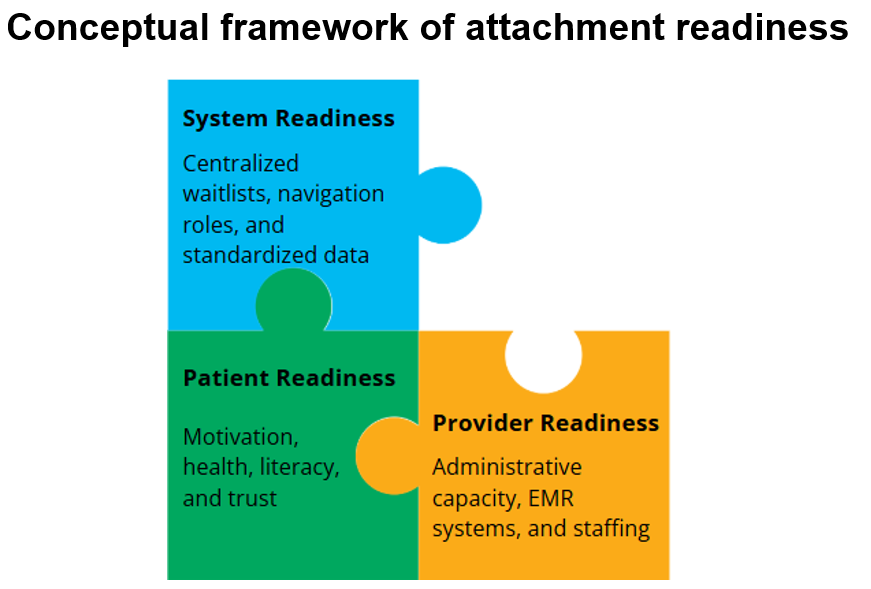
To achieve sustainable continuity of care, policy must shift from volume-based matching to a readiness-informed approach that invests in navigation infrastructure, reduces clinician burnout, and standardizes intake processes across the primary care landscape.
What needs to be done
Shifting the focus to readiness yields significant benefits across the healthcare ecosystem. For patients, particularly those facing social determinants of health barriers, it ensures a transition characterized by trust and cultural safety rather than administrative confusion. For providers, it reduces the “friction” of new patient intake—such as medication reconciliation and chart creation—which currently acts as a deterrent to accepting complex cases. At the system level, this approach improves the quality and sustainability of matches, leading to better preventive care, earlier disease detection, and reduced systemic costs.
By treating readiness as a prerequisite, jurisdictions can move from high-volume, low-retention matching to high-quality, continuous care.
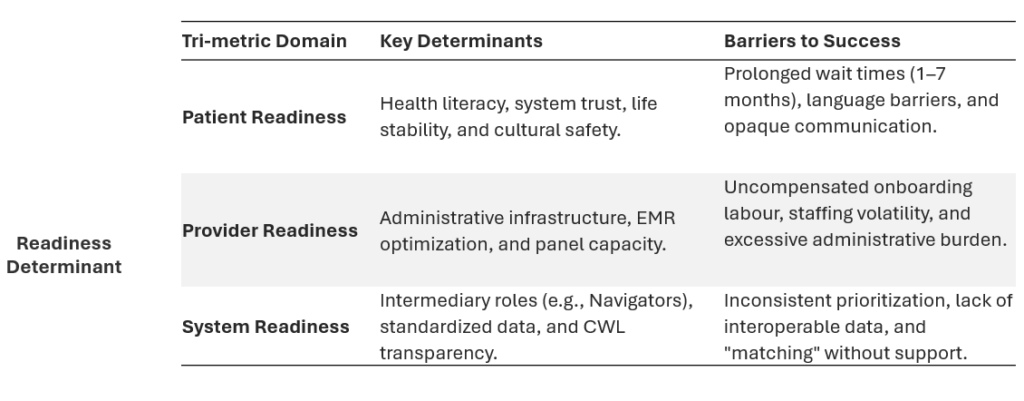
Standardize Onboarding
Create digital intake systems that speak to each other can reduce duplication and improve communication within the system and between providers and patients.
Prioritize Vulnerability
Move beyond “first come, first served.” Build with the realities of social and clinical complexity in mind, including the need to engage with communities, not simply wait for them to reach out for care.
Support Provider Capacity
Recognize the labour and work of patient onboarding, by investing in team-based models, and formal, strengthened navigation roles.
Measure Readiness – not only attachment numbers
Include onboarding and retention indicators that go beyond matching numbers.
Ultimately, if the primary care system is not ready to provide culturally responsive, equity-centred health support, particularly for those already vulnerable in the healthcare system, then attachment is just a metric on a spreadsheet, not a pathway to wellness.
View/download related presentations made at the Alliance for Healthier Communities 2026 conference:
Related presentations
Kasia Filaber, Manager, Health Initiatives, Access Alliance, provides an overview of our recent research exploring the need to rethink primary care attachment as a relational and system-supported process.
Sarah Hobbs, Chief Executive Officer, Alliance for Healthier Communities provides an overview of – Bridging the Gap: A Multi-Level Analysis of ‘Rapid’ Primary Care Attachment Readiness.
Related Access Alliance activities
Advancing health equity, strengthening attachment readiness, and improving mental health outcomes for Black children and youth
Access Alliance’s annual Community-Based Research Retreat Day in 2026 focused on advancing health equity, strengthening attachment readiness and systems of care, and improving mental health outcomes for Black children and youth community members.
Evidence-driven equity: Turning community knowledge into healthier, fairer systems for immigrants and refugees
The 2026 Annual Research Impact Report of the Community-Based Research (CBR) and Evaluation Department at Access Alliance presents a compilation of our team’s scholarly contributions, methodological advancements, and initiatives from April 2025 to March 2026.