
What gets measured gets improved – our annual client experience survey
This research-like activity is about understanding the client experience within Access Alliance’s primary care services. It focuses on gathering feedback from patients who visited one of the organization’s three main sites (Jane, College, and Danforth) or accessed care virtually between November 2025 and February 2026.
Overview and context
We operate within a community healthcare model defined by health equity and social inclusion, serving a highly diverse population. Our Client Experience Survey provides a glimpse into patient experiences with Access Alliance’s primary care services. Each year, we collect patient feedback to ensure service accountability, quality improvement, and evidence-informed practices.
The report measures performance across five key quality domains: satisfaction, accessibility, equity, patient-centredness, and client safety. The guiding questions revolve around how well we are meeting our strategic goals of providing equitable, person-centred care and where improvements are needed to address systemic barriers. As stated in the report’s introduction, the survey serves as a “critical instrument for institutional accountability, facilitating continuous quality improvement (CQI) and the refinement of culturally responsive care frameworks.”
This report helps us ensure that our primary healthcare services meet our diverse patient needs.
What we learned
The full report provides cross-sectional data on the selected indicators, and also a comparison of a number of trends over the past 5 years. For example, while there has been some fluctuation in satisfaction ratings since 2020, overall satisfaction ratings remain above 90% across all sites. At the same time, there is a decrease in patients reporting the opportunity to ask questions about treatments (5% fewer than last year) and the opportunity to ask questions about treatment (4% fewer than the past year).
Assets and strengths:
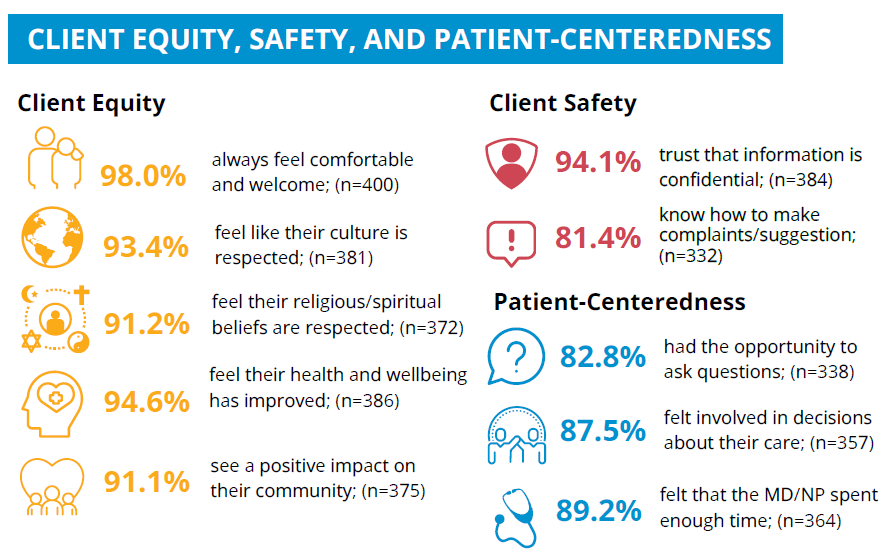
We found overwhelmingly high levels of satisfaction and a strong sense of equity among clients. Overall, 98.1% of the 408 respondents rated their care excellent, very good, or good. 96.3% of clients said they would recommend Access Alliance to friends or family. Satisfaction is high across different demographics, though statistical analysis showed that gender did significantly influence satisfaction levels, whereas age did not.
In terms of service accessibility, 87.8% of patients received an appointment on their preferred date, and nearly 30% were able to see a provider on the same or next day, marking an improvement from the previous year.
Areas for improvement:
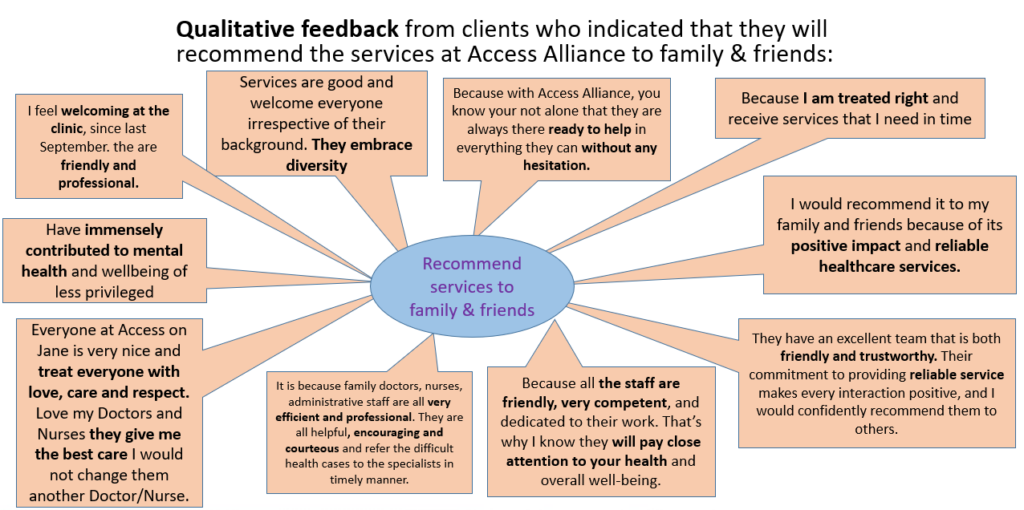
While 95.59% of patients felt treated with dignity and respect, there was a slight decline in patient-centredness indicators compared to previous years. Fewer patients reported having the opportunity to ask questions about treatments (dropping by approximately 5%) and feeling involved in care decisions. Qualitative feedback highlighted challenges such as difficulty reaching staff by phone, long wait times, and the high cost of prescription medications. While only four respondents reported using virtual appointments, those who did express mixed feelings, with some citing privacy concerns and difficulty explaining health issues remotely, while others noted greater benefits compared to in-person visits.
Overall Recommendations
- Maintain and sustain effective practices of service provision to ensure continued positive client experiences, consistent quality of care, and responsiveness to community needs.
- Strengthen staff training in trauma-informed care to support inclusive, patient-centered care and ensure clients are meaningfully engaged in treatment planning and decision-making.
- Improve patient communication by developing clear, easy-to-understand materials on Access Alliance resources (including virtual care, community programs, and translation supports) and providing guidance to strengthen use of the Oceans (online booking platform) for appointment scheduling.
- Increase responsiveness to phone inquiries by implementing call response standards and tracking wait times, ensuring culturally responsive communication, and strengthening follow-up processes for appointment updates and test results.
- Improve timely access to care by expanding same-day appointment capacity, optimizing scheduling processes, and strengthening triage pathways for urgent needs.
- Enhance inclusiveness in service delivery by consistently offering language interpretation services across all patient touchpoints, including intake, booking, and clinical encounters, and ensuring staff actively document and use preferred languages.
- Expand patient support by proactively providing tailored health information and navigation assistance, helping clients connect to relevant community resources and services in a more coordinated and holistic way.
How we can use this information
For practitioners and clinic staff, the findings suggest a need to strengthen training in trauma-informed care and improve communication strategies to ensure patients feel fully involved in their treatment planning. Our report recommends developing clearer materials on virtual care and navigation tools to help patients use online booking systems effectively.
For administrators and policymakers, the data provides a roadmap for resource allocation, specifically highlighting the need to expand same-day appointment capacity, improve telephone responsiveness, and invest in language interpretation services across all touchpoints.
For funders and accreditors, the report demonstrates the organization’s commitment to accountability and continuous quality improvement, showing that despite challenges, the core mission of equitable care is being met.
For future researchers, the report identifies a need for further study on the barriers faced by clients with disabilities and the specific challenges of virtual care delivery in multicultural settings.
What we did
We used a mixed-methods approach, combining quantitative survey data with qualitative feedback to capture real-time experiences. We used inclusive recruitment strategies, including translated surveys in Portuguese, Spanish, Arabic, Farsi, and Tigrinya.
We offered multiple ways for clients to provide feedback, including in-person, email, and phone, to ensure representation across diverse client groups, including those without digital access. Data collection occurred through three modes: in-person (using iPads or QR codes for respondents to use their own devices), email (sent to 3,139 clients), and phone (calls made to 148 clients).
We recruited and trained volunteers to conduct data collection, ensuring an anti-oppressive framework was used when approaching clients. The survey was administered to clients who had visited a doctor or Nurse Practitioner at least once during the study period.
We collected a total of 408 usable surveys, representing a sample size that exceeded the minimum requirement for accreditation. The demographic profile of the respondents was compared against the broader client base from the 2024-2025 fiscal year to ensure representativeness.