
Evidence-driven equity: Turning community knowledge into healthier, fairer systems for immigrants and refugees
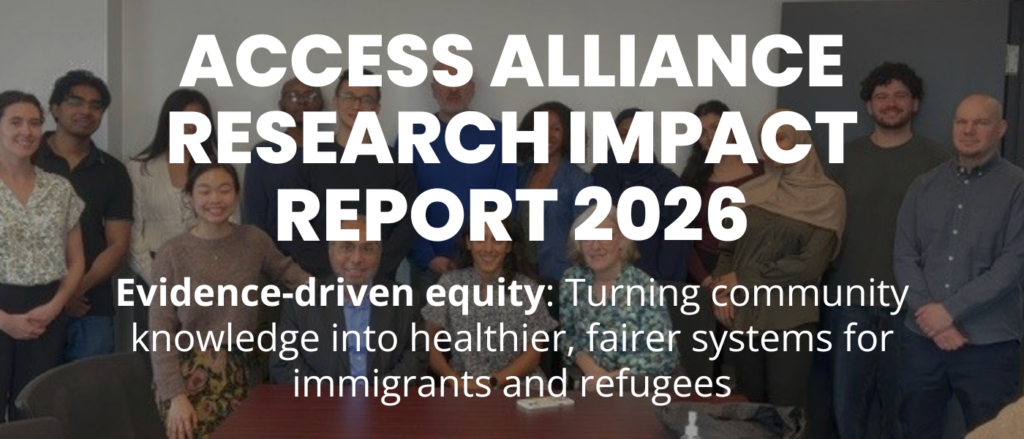
The 2026 Annual Research Impact Report of the Community-Based Research (CBR) and Evaluation Department at Access Alliance presents a compilation of our team’s scholarly contributions, methodological advancements, and initiatives from April 2025 to March 2026.
At Access Alliance we turn community knowledge into evidence, evidence into policy, and policy into systems that are healthier and fairer. It is not just research—it is a mechanism for equity-driven change. It is used to improve lives, strengthen systems, and advance equity through evidence-driven action. Research is a rigorous instrument for informing social policy that can advance public accountability. By situating our work at the intersection of health equity and community-engaged practice, we generate evidence that illuminates the structural determinants of health disparities and addresses temporal uncertainties.
We are committed to a participatory research framework grounded in data ethics, inclusion, and community partnership. We employ rigorous mixed-methods approaches to engage equity-deserving populations, including immigrants, refugees, and racialized communities, to better understand the multidimensional barriers affecting health and social well-being. We strengthen research paradigms that emphasize shared leadership and reciprocal learning, recognizing lived experience as a legitimate and valuable form of expertise. Careful ethical stewardship ensures that informed consent, data governance, and meaningful community benefit are foundational principles across our work.
Our research portfolio is as an important evidence base for organizational planning, service improvement, and policy advocacy. Through analyses of the social determinants of health, evaluations of community-based interventions, and applied knowledge translation activities, we bridge the divide between empirical inquiry and practical implementation. Our findings reinforce the value of community-centred models of care, demonstrating that interventions informed by local context and grounded in evidence are more likely to produce sustainable and equitable outcomes for historically marginalized populations. The trust, collaboration, and commitment of our valued community partners, research participants, staff, and funding organizations make this work possible. We remain steadfast in our dedication to advancing ethical, transparent, and transformative research that meaningfully reduces health inequities.
We invite you to engage critically with our report, reflecting a continuing commitment to support a more equitable, inclusive, and evidence-informed public health landscape in Toronto and beyond.
What you’ll find inside
This document outlines our success across three distinct levels, to ensure our research drives both immediate care improvements and long-term structural shifts.
The individual level: The Immigrant Researchers Support Network (IRSN),Student placements, training and support of Peer Researchers serve as a strategic commitment to building a sustainable pipeline of professionals who are reflective of, and responsive to, the communities they serve.
The organizational and community level: Our Learning Health System model transforms Electronic Medical Record (EMR) data into actionable insights for our Board and management, ensuring organizational resources are allocated based on real-time clinical trends. The Youth Service Needs Assessment (YSNA) provides an essential evidence base for community organizations supporting neighbourhoods frequently overlooked in provincial planning. The Rockcliffe-Smythe and Mount Dennis (RS-MD) CHNA identifies vital local assets and concerns, providing a foundational tool for sustainable community development tailored to neighbourhood-specific needs. Our work in Expressive Arts demonstrates that culturally responsive care requires moving beyond traditional clinical settings. By integrating trauma-informed, arts-based practices, we help newcomers rebuild their sense of identity and belonging. However, our research also uncovers deep-seated barriers. The Seniors’ Medication project provided a “health care system reality check” when 95 seniors expressed a profound lack of trust in the system.
The policy and system level: The Black Children and Youth Mental Health Project advocates for non-carceral, public health-based crisis response models, challenging traditional institutional frameworks to adopt more equitable standards. Through the BETTER for All (BFA) project and our Attachment Readiness framework, we have identified that clinical success is contingent upon system readiness. Our Attachment Readiness research advocates for a shift from volume-based matching to a standardized provincial onboarding infrastructure that centres equity, preparing the system to support complex newcomer cases effectively.
Download the report
Presentation overview
At our May 20, 2026 Community-Based Research Retreat Day Courtney Kupka, Access Alliance’s Research and Evaluation Coordinator, presented an overview of our research and evaluation efforts and impact over the past year. She focused on how we work to turn community knowledge into healthier, fairer systems for immigrants and refugees.
Related Access Alliance activities
Community Knowledge, System Impact A Decade of Research Leadership at Access Alliance (2025)
Aiming for strategic impact on healthcare system equity, the Community-based Research Department at Access Alliance has generated a substantial body of peer-reviewed scholarship, internal evaluation reports, community research snapshots, and public-facing knowledge mobilization outputs over the past decade. This publication synthesizes the breadth and depth of our research contributions across intersecting domains of immigrant and refugee health, social determinants of health, labour market precarity, gender-based violence, digital and virtual care, and equity-informed service design.